MEETING OLD PUPILS
Saturday, May 09, 2015
My last post, in May 2011, mentioned that my ex-pupils might not remember me after all these years. I was wrong. Most of them do remember me still while I forgot most of them. One of them started a WhatsApp group and tracked down a few teachers including me.
I was surprised that there is a number of my ex-students living in the Klang Valley. Being a curious old coot, I suggested a meeting in the Klang Valley. One of the Klang Valley residence happens to be an event organizer thus he and our former Scout Troop Leader started the ball rolling.
We met at a hotel in PJ. I was overwhelmed by the love that exuded from my ex-pupils. They were all successful in their respective fields - top civil servants, top planters, top managers and top crime-fighters. One of them had a hand in creating Malaysia's first atomic clock (go here:
mst.sirim.my and adjust your watches and clocks).
They all came not just from around Klang Valley but all the way from Terengganu , Pahang and negeri Sembilan.
Thank you ladies and gentlemen. I celebrated Teachers Day earlier this year. Alhamdullillah
Happy Teachers Day!
Tuesday, May 17, 2011
I was a teacher once. I do not know whether any of my students remember me. It does not matter. I have done what I was supposed to do and that’s that.
I remember most of my “cikgu”.
I was short of the school-going age when I was in Merang but my father put me in school anyway. Most probably to get me out of my mother’s hair. I do not remember any of my teachers name in Sekolah Melayu Merang. What I remember is one of mother’s cousins, Pok Kob, who was in the upper classes, feeding me with cuklat nissang every now and then. I remember too going with him through the field looking for a kind of grass to wipe the papan slate. I guess the teachers left me alone. That was the reason I could not remember their names. But I do remember the headmaster, Cikgu Weil. Cikgu Weil, a wiry dark-skinned man from Pahang was the local UMNO leader. Then (in 1949), nationalism was spread by, among other groups, teachers like Cikgu Weil. He went around shouting “Merdeka” at every opportunity. The kampung folks would respond with a hearty “Deka!” or “Deko!” depending on the dialect they were used to. I was not sure whether it was the nationalistic fervour or their dig at Cikgu Weil’s physical impediment. Cikgu Weil could not straighten his arm – an affliction known in Terengganu as “deko” (or “deka” if you are from Besut).
When we moved to Kuala Terengganu, I was enrolled in Sekolah Melayu Paya Bunga and we had a few unforgettable cikgus. One was Cikgu Lebo, a short rotund man who never seem to smile. Cikgu Lebo went around the school ground during recess to debok (thump) the back of pupils drawing on the sand.
When I moved to Sultan Sulaiman Primary school after getting through the Special Malay Class examination, our favourite teacher was Mr. Lau Kuan Jin who drilled us in English with a litany of “ A man in a pan” or was it the other way around? Actually it was “A man and a pan”. I am getting old.
When we moved to Kota Bharu, I remember Mr. Henry in SIC. He took us on expeditions to a waterfall in Pasir Putih. Later when I moved next door to the secondary school, we had Ustaz Abdullah Nakula who always tweaked our brain with trick questions. We also had a Mr. Menon who was overcome with passion on reading a passage from Shakespeare.
In Sultan Sulaiman Secondary School, Kuala Terengganu I remember many teachers who undoubtedly played a part in my life. There was Cikgu Rahman who encouraged my infatuation with art and Mr. Gurunathan, our Scout Master. And then there were the ustazs , Ustaz Mahmood Salim and Ustaz Manan. They never failed to liven up the class while giving us the basics of Islamic Studies. Ustaz Manan was unfazed by our silly questions. An example:
Student: Apa hukum hisap kopek bini kita ustaz? (Whats the rule on sucking on your wife’s tit?)
Ustaz: Hukumnya sedaplah. (Feels good.)
There are many more teachers that I remember from those days. To them and to all the teachers past and present, Happy Teachers Day, Cikgu!
Labels: Teachers
Happy Teachers Day!
I was a teacher once. I do not know whether any of my students remember me. It does not matter. I have done what I was supposed to do and that’s that.
I remember most of my “cikgu”.
I was short of the school-going age when I was in Merang but my father put me in school anyway. Most probably to get me out of my mother’s hair. I do not remember any of my teachers name in Sekolah Melayu Merang. What I remember is one of mother’s cousins, Pok Kob, who was in the upper classes, feeding me with cuklat nissang every now and then. I remember too going with him through the field looking for a kind of grass to wipe the papan slate. I guess the teachers left me alone. That was the reason I could not remember their names. But I do remember the headmaster, Cikgu Weil. Cikgu Weil, a wiry dark-skinned man from Pahang was the local UMNO leader. Then (in 1949), nationalism was spread by, among other groups, teachers like Cikgu Weil. He went around shouting “Merdeka” at every opportunity. The kampung folks would respond with a hearty “Deka!” or “Deko!” depending on the dialect they were used to. I was not sure whether it was the nationalistic fervour or their dig at Cikgu Weil’s physical impediment. Cikgu Weil could not straighten his arm – an affliction known in Terengganu as “deko” (or “deka” if you are from Besut).
When we moved to Kuala Terengganu, I was enrolled in Sekolah Melayu Paya Bunga and we had a few unforgettable cikgus. One was Cikgu Lebo, a short rotund man who never seem to smile. Cikgu Lebo went around the school ground during recess to debok (thump) the back of pupils drawing on the sand.
When I moved to Sultan Sulaiman Primary school after getting through the Special Malay Class examination, our favourite teacher was Mr. Lau Kuan Jin who drilled us in English with a litany of “ A man in a pan” or was it the other way around? Actually it was “A man and a pan”. I am getting old.
When we moved to Kota Bharu, I remember Mr. Henry in SIC. He took us on expeditions to a waterfall in Pasir Putih. Later when I moved next door to the secondary school, we had Ustaz Abdullah Nakula who always tweaked our brain with trick questions. We also had a Mr. Menon who was overcome with passion on reading a passage from Shakespeare.
In Sultan Sulaiman Secondary School, Kuala Terengganu I remember many teachers who undoubtedly played a part in my life. There was Cikgu Rahman who encouraged my infatuation with art and Mr. Gurunathan, our Scout Master. And then there were the ustazs , Ustaz Mahmood Salim and Ustaz Manan. They never failed to liven up the class while giving us the basics of Islamic Studies. Ustaz Manan was unfazed by our silly questions. An example:
Student: Apa hukum hisap kopek bini kita ustaz? (Whats the rule on sucking on your wife’s tit?)
Ustaz: Hukumnya sedaplah. (Feels good.)
There are many more teachers that I remember from those days. To them and to all the teachers past and present, Happy Teachers Day, Cikgu!
Labels: Teachers
LABORIOUS SUNDAY
Monday, May 02, 2011
Whew! What a Sunday!
Early in the morning I was woken up from my second session of sleep by the phone. It was Pak Daud who said he was downstairs with Ani, his wife. After accepting with heartfelt thanks the
sambal belacan that Ani pounded in her kitchen back in Tanjong, Kuala Terengganu and the inevitable
kerepok, we let our guests head for hot showers.
We had to forgo
nasi dagang for breakfast (they served
nasi dagang at Tappers, Bangsar South) but opted instead for Western fare at Plan B, Bangsar Village. We had to attend a birthday party for my
cucus and presents had to be bought while the Terengganu couple finished their eggs and lemon tea.
My daughter Dalia is usually a very good communicator but since leaving the tv station, she is a bit harried. So she forgot to tell me where the party was. I assumed that since previous birthdays were celebrated in their house, this year would be no different. So Pak Daud, Ani and I made our way to Kelana Jaya. We made a stop a few houses away from Dalia's house because Pak Daud wanted to drop off some
kerepok for Hj.Shariff, a fellow cycling official.
When we arrived at Dalia's house, there was no sign of any festivities. There weren't any sign of anybody. A phone call cleared the misunderstanding. The party is at The Club, Bandar Utama.
At this time, Plan B's breakfast started to trouble Pak Daud's generally robust tummy. He needed a toilet for the big one. Is there a jambang ija equivalent around? None. Dalia's house was locked. Elisa's house nearby seemed to be locked too. Luckily the mosque was not locked.
Relieved, we set for the club. After the tunnel, I missed the turning and had to make a fool of myself by going into the road people use to exit, not to enter. I was told to look out for the Club signs.
I looked. Pak Daud looked and read out each sign. We ended up at the foot of the hill. No club in sight. We did see a police station. After another two attempts we finally got the club.
I promptly got shot by Akif with his newly acquired water gun.
We left at 2pm and had to get home first because Daud forgot his copy of A Map of Terengganu he bought in Kuala Terengganu earlier.
We made only one wrong turn going to Solaris but when we got to Block A. We found the door locked. We managed to find the proper entrance and found RA Gallery already packed with fans and guests. I managed to squeeze Daud to the front. He found a chair on his own though.
Alhamdullillah were not too late to catch the Syair Awang Goneng followed by Awang Goneng's raconteur of his school days and journalistic experience.
I was glad I came. I met the host Raja Ahmad, a very pleasant gentleman. I met Dina Zaman again. She was perky as always and a joy to listen to. I met Cat In Sydney, a faithful follower of my blog. She is not at all catty. When I was sneaking a cigarette, Blabs caught me. Havent seen her since she came back from Dubai. I also talked to bubbly Dato' Manja and wife for the first time. Although Puteri Kamaliah wanted to talk to me more because I left MPH early yesterday she did not get her wish. Too many people.
I did not want to rush for the food, preferring to wait. I didn't get to taste
jala mas but managed to get the fabulous
sekaya. Thank you Wan Asma. I left the remaining
ropa to Adnan. He has stronger teeth. I have only gums.
My flash gun fell down and I did not take many pictures. See whatever I have
here.
A MAP OF TERENGGANU-THE SIGNING
Saturday, April 30, 2011
Excuse the dust. I am clearing the cobwebs after neglecting this blog for a few months.
The problem with blogs with a specific subject/theme is you can run out of ideas sooner than expected.
Anyway, enough of excuses.
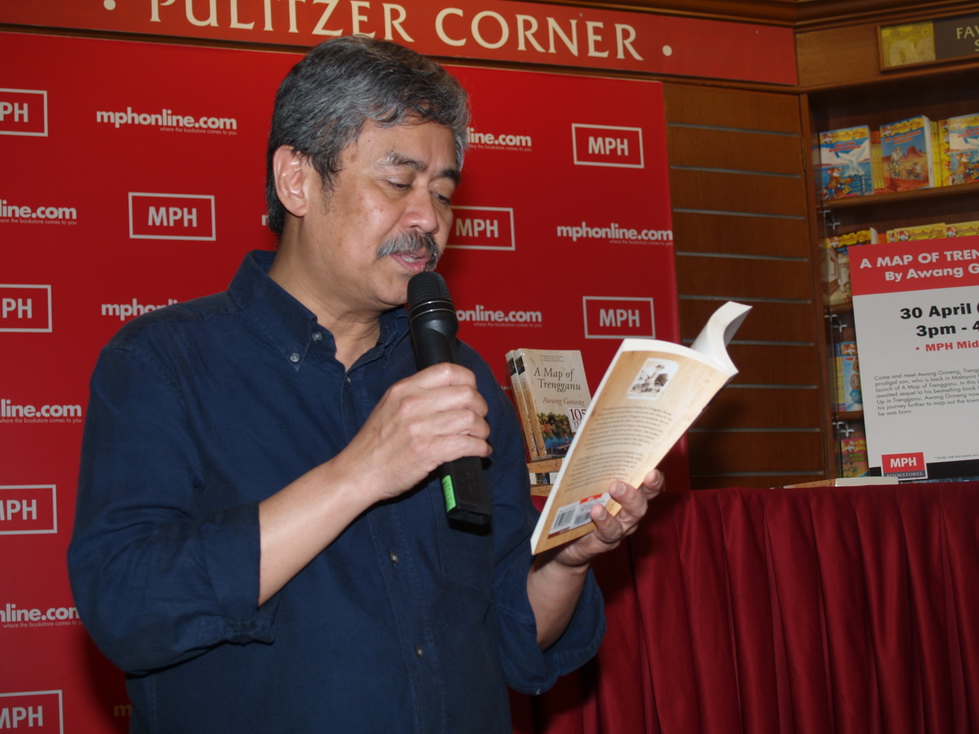
I am just back from MPH Mid Valley where my friend Awang Goneng had his book signing.


Awang Goneng skipped The Wedding and came to KL

with Zaharah,

their daughters and a very sunburnt friend (not in picture, too hot). The cats could not make it.

The Children's Section of MPH where the event was held was crowded with fans and friends

including our Sasterawan Negara.

Awang Goneng briefly disclosed how the book came about and generously shared some secrets of writing, publishing and blogging.

As with GUIT, Awang Goneng read a chapter from A Map of Terengganu before autographing the books.

The line was long. I was glad mine was signed earlier.

Among those patiently waiting were people from the families mentioned in the book.

The signature is going to be worth a lot some day.
I wanted to wait for Awang Goneng to finish and have tea with him but I saw that the line was too long and decided to go home. I will be meeting him again at Solaris, Dutamas tomorrow, insyaAllah.
TERENGGANU TAKES #4
Thursday, December 16, 2010
Most of my trips to Kuala Terengganu found me in Merang where I like to catch up on my fishing. Most of my classmates and friends are in Kuala Terengganu and they do not fish.
On my last visit, the weather was not conducive for fishing and I had the time to reconnect with my old friends. Take "old" in any way you like and it will be true.

Mat Nong, our class monitor insisted that we have tea at his house in Durian Burong. Ramli took his van and we picked up Hj. Hassan along the way. Daud, who was tending his goats chose to make his own way by motorbike.He did not expect the rain to be so heavy and he came soaked to the bone. We did not allow him to come to the table until he changed into some dry clothes provided by our host.

After enjoying the
mee siam, keropok lekor and other Terengganu goodies, Mat Nong insisted on a group photo.

Prior to that, Daud wanted to show off his
pawang skills by looking at Hassan's belly button. Nothing came out of it except maybe for some lints.

Later we caught up with Dato' Kadir Sulaiman at Permai Inn. Dato' Kadir was in Terengganu as a Labour Officer and later as the Legal Adviser. Now he has gone on to loftier appointment but found the time to meet old friends.

Unknown to me, Dato' Kadir also brought another mutual friend that day. Mr. Chua was my partner-in-crime during my madness for good hi-fi. He owned an electrical shop in Jalan Banggol and let me have all the equipment that I wanted even though most of the time I could not pay cash. It was indeed a pleasure to see Mr.Chua again. He told me that he is now retired. Looks like I have to get the Blu Ray player somewhere else.
TERENGGANU TAKES #3
Friday, December 10, 2010
Kuala Terengganu in December might look gloomy. There are rain-clouds over the city.

On the ground, everyone is prepared for the rain, even the hardy usually waterproof "teksi" men. Trishaws are called teksi in Terengganu while what city folks taxis are called "kereta sewa". This particular guy made doubly sure he doesn't get wet.

Visibilty from my window is limited. The sea is misty but still gentle. It is still early in the morning. The sun is still not up.

Further inland as in this kampong in Darat Batu Rakit, the monsoon rain turned fields into lakes.

And the boats at Merang jetty take a rest from their daily runs to Pulau Redang and Pulau Lang Tengah.

The tourists instead flocked to Pulau Duyong. They saw a fiercer monsoon this time around.

Labels: monsoon, Terengganu
TERENGGANU TAKES #2
Friday, December 03, 2010
When I was in Kuala Terengganu last February, I found out to my dismay that most restaurants in town were closed on Friday. Some popular
warongs too took Fridays off. On other days of the week however, you can feast on many Terengganu delights. On my latest trip back home I did not starve. I even had
nasi dagang twice on the same day. Once for breakfast and when I went for the
tahlil in the evening,
nasi dagang was on the menu. This was on the second day. On the third day, my breakfast was
laksam (East Coast flat noodle) bought at a
warong in Tanjung. I would not eat
laksam without toasted
belacan so my good friend Pok Daud asked his wife Ani to toast some for me, crushed it and brought it lovingly wrapped in tissue paper.
Lunch on the first day was at Coffee Beans, KL Sentral. Nothing memorable. On the second day another bosom buddy Pak Ramli brought me to a popular mee bandung stall next to the former Cathay cinema hall. The owner refused to take my money. Turned out that she was Ramli's sister.
On the third day we drove up to Merang. Ramli wanted to check up on his boat and I was salivating thinking of the ebek fish that we wanted to have for lunch. Unfortunately, the owner of the warong told us he no longer prepares lunch. He said he was too tired. I suspected that he was too rich already. He only serves breakfast. We were lucky that there was some nasi minyak left. I grew up on Tengku Hussin's nasi minyak and found this version edible but not spectacular.

Before I left for Kuala Terengganu I promised Mimi to bring home some otak-otak. Mimi needs some convincing that Terengganu's otak-otak are far superior than those fish-flavoured paste they passed off as otak-otak in the Klang Valley. We found one place selling otak-otak somewhere in Mengabang Telipot. There were not many left so we bought all.

The place also sells
sata (also fish-based).
Sata are grilled on a bamboo skewer but we were not allowed to take the skewers. The sata from here were delicious but not as heavenly as those at Pak Man's place at the food court near Sutera Beach Resort. Unfortunately, Pak Man moved elsewhere already.

As the plane was landing in Kuala Terengganu, I, for some inexplicable reason, thought of fried bananas. So as soon as I could, I rang my classmate Hj. Hassan inviting him to a
goreng pisang tea. I asked him where the best
goreng pisang can be found. Three generations ago, I would not ask Hassan that. Everyone knew then that the best
goreng pisang (and
kerepok lekor) would be at Mok Nik Awang Itam in front of Paya Tok Ber. Even the
istana bought fried bananas and
kerepok lekor from her. Hj. Hassan told us to wait for him at LAN BANANA a short distance from the Simpang Tokku roundabout.
It was not even tea time yet but the there was already a queue even though the line was a bit ragged. Lan Banana sells fried bananas, fried sweet potatoes, fried fish in batter (or as Terengganu folks call them ICT
-ikan celup tepung) and of course fried
kereopok lekor. This would be a place your cardiologist warned you about.

There wasn't any place in the establishment where you can sit down comfortably and eat the stuff you have bought. Neither do they sell coffee or tea. So Hassan got the
goreng pisang,
kerepok lekor as well as ICT and we headed to his house where we enjoyed the crispy and cholestrol-laden items. After tasting the
goreng pisang I can see why there was a queue. I even forgot that they should call the fried bananas
pisang goreng.
Labels: Terengganu Food